Wednesday, April 17, 2013

"Very good con papas"


After having a packed schedule every day for the past three months until now, I didn’t know what to do with myself when I arrived at Cerro Punta in the heart of the agricultural highlands of Panama without any schedule at all. I’m here working with a local group of farmers called GORACE (Grupo Orgánico de Agricultores Cerropunteños) on my independent project about the organic certification process and how it can be improved. My host family is adorable; Don Roger and his wife Nella have already insisted I am like their daughter. I have already noticed my Spanish ability increasing just by talking with them for the past few days. Although their house is not exactly the quaint farmhouse I’d originally imagined for my ISP, it has a gorgeous view and the softest bed I have ever slept in.


Also they have a goat, whose name I forget right now, but it responds to its name with a "maaa."
Yesterday I spent two hours chatting with Don Roger after breakfast about everything from politics to technology in the usual fashion of conversations with elderly people nostalgic for the past and concerned for the future. He is a character and I love how animated he gets when he tells stories. While his mumbling is sometimes tricky to understand, I think I got the gist of the first story he told me over dinner. It’s about gringos who try to order food at a Panamanian restaurant without knowing what the food is called. All they know is that someone told them the food is “very good” so they order “Very good con papas.” Or something like that. I’m definitely missing a key part to that story, but now he repeats the phrase whenever we eat, depending on what we eat: “very good con patacones,” “very good con huevos,” etc. It always makes me smile, despite not understanding the story completely simply because he gets such a kick out of it.
I still cannot seem to escape the typical Panamanian idea that fried food is good food and ate Spam for the first time yesterday, but at least I get lots of fresh vegetables too. My favorite dish so far is “la pizza cerropunteño” which has peppers, onions, carrots, celery, and cheese! I also discovered the delicacy that is “papallitas,” which is like a syrupy kind of fruit that tastes something like a mixture of thick jam and honey.

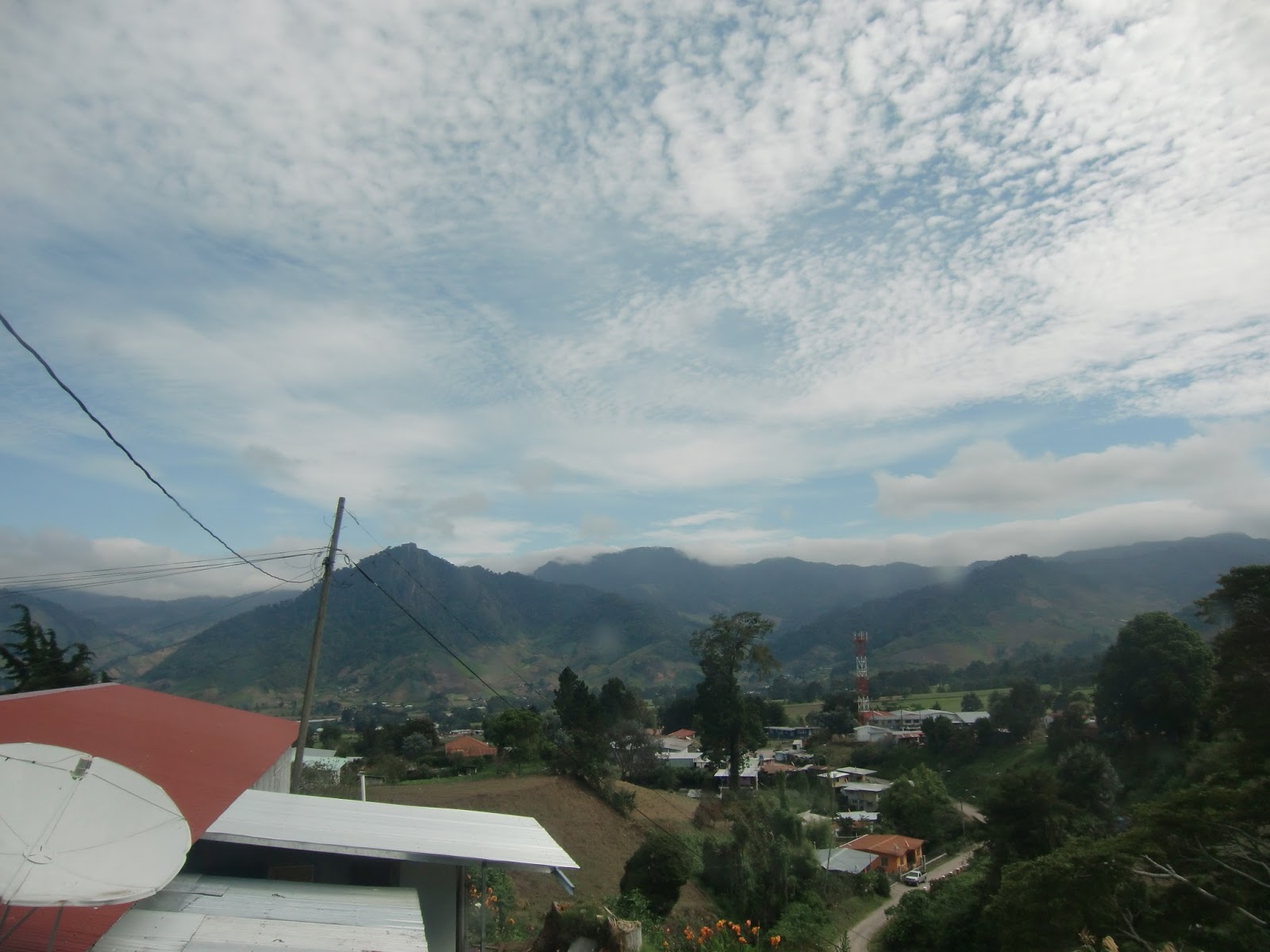
The town of Cerro Punta is very quaint and filled with mini-supers and suppliers of agrochemicals and farming equipment. Thankfully I was able to find two different places with internet that I can rely on, although one of them smells faintly of fish for some reason so I’ll use that one as a last resort. I honestly still can’t quite wrap my head around the fact that I’m living here with a family completely on my own. There are other students in towns nearby so hopefully we can visit each other sometime, but it’s nice to have my own schedule and to be staying with an elderly couple who treat every day like a quiet Sunday. I am thrilled to watch the news again, something that I did a bit in the city but didn’t’ have access to during our travels. Without internet in the house, I feel more attached to the TV to keep me informed of what is going on in the rest of the country and the world. I was especially shocked and saddened to hear about the attack in Boston. My thoughts and prayers are with the victims and their families. There has been nonstop coverage about it here in Panama; Panamanian news has lately been focusing on international news almost exclusively between the attack in Boston and the election in Venezuela.
I am finally able to understand television announcers, which is a very exciting accomplishment. My next goal is to understand the characters who speak a mile a minute in telenovelas, like those in “El Man es German.” That show quickly became my favorite possibly because it is reminiscent of old Disney channel shows due to the sheer goofiness and younger characters compared to other telenovelas.
Today I had my first adventure here trying to meet my adviser in the next town over. Due to an unfortunate series of events, I missed the bus stop and ended up in the middle of nowhere halfway between two towns. Needless to say I was frustrated with myself and the bus attendant who knew clearly where I wanted to get off but didn’t say a word when I missed my stop, but you can’t stay too mad for too long when you’re walking with a view like this:


Thankfully, after 15 minutes of walking, a wonderfully helpful couple in a pick-up stopped to help me and they kindly brought me to the bus stop I needed, explaining that the restaurant that was supposed to mark my stop was recently closed and knocked down. After dozens of other cars (including that stupid bus that let me miss my stop) simply passed me by or just gave me “piropos” (one was even in the form of a bark shouted from a passing truck), the kindness of that elderly couple was just what I needed to replenish my faith in humanity.
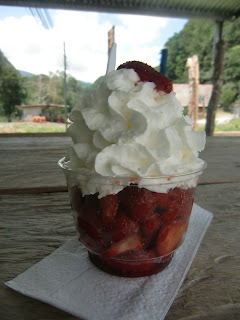
So naturally, after my successful meeting with my adviser I treated myself to some “fresas con crema” for lunch, which was fantastic. Quite the successful adventure.


The quick re-cap of our journeys post-Naso is that we visited a fair trade banana plantation in Changinola, where I realized that even fair trade standards are not perfect and therefore I will never buy a regular Chiquita banana ever again, and then we toured a sustainable cacao farm where I learned that cacao fruit is alien-like but absolutely delicious.


After Changinola, we crossed the border to Costa Rica via the sketchiest wooden, rotting bridge I’ve ever crossed on foot while carrying all of my belongings on my back.


In Costa Rica we stayed in homestays for a few days in a rural farming area and it was like a mini-vacation. We had coffee three times a day, swam in the most gorgeous river I’ve ever seen, took an afternoon siesta, watched dubbed movies at night,  and played dominoes with our host dad before going to bed around 9pm. He was quite the storyteller and welcomed us to his house with various stories of how people have threatened him so they can cut down the forest on his land to sell the wood, so I was a little concerned that we might be poisoned while we were there by some bitter neighbor, but other than that, it was like paradise.


Then we toured EARTH University and wow! It was as if someone decided to take my dream university and make it reality. They teach all sorts of sustainable farming and development courses with students from all over the world and I fell in love with it. I am even considering applying for an internship there after graduation from Villanova to study sustainable agriculture and development. Here are some photos of their organic garden and the campus, which were both absolutely gorgeous.


After Costa Rica, we took a tiny plane back to Panama City where we had a few days to prepare ourselves for our ISP. One of those days we took a day trip to Barro Colorado Island, where there is another Smithsonian research station and we finally got to go on a nature hike where we actually saw wild animals, including lots of adorable agouties! And I am still in awe of this 300 year old tree!


TodayI get to meet all the other farmers in GORACE and I’m excited and nervous and just hope I can get to the meeting location without getting lost this time!

Friday, April 5, 2013

Bocas del Toro and the Naso Territory


It’s truly overwhelming and wonderful how many new experiences I’ve had in just a few weeks. Last week I snorkeled off of Caribbean islands at the Smithsonian Tropical Research Institute (STRI), and then I spent the past two days living in the Naso indigenous community along Río Teribe.

Our schedule at STRI was crazy, but snorkeling was an incredible experience. The water in the Caribbean was so clear and the reefs were much more diverse than those in the Pacific. We would go out every morning and practice identifying species in the field, collect samples to bring back to the lab, or do transect surveys of sea grass beds. It was fun to be able to look just a few feet below you and see a whole different world brimming with life. I held a sea cucumber and it was the strangest feeling. I also held sea biscuits, starfish, and sea urchins and examined mangrove roots and dead coral to study all of the crazy worms and invertebrates that live in them. My favorite memory was on the third day after doing a difficult transect survey in extremely choppy waters. We stopped by a beautiful mangrove island surrounded by reef and swam for about an hour among huge schools of sardines and all different types of coral. It was like a scene from Finding Nemo! On the boat ride back to the research center, the sun shone through the clouds after being hidden all day and it couldn’t be more perfect.


We also watched a movie called “Paraíso for Sale” about how the indigenous Ngobe land in Bocas del Toro is being illegally taken by companies to build tourist attractions. I encourage you all to watch this short film, as it fully explains the plight of the Ngobe in Bocas. I made me realize the importance of doing your research when you are a tourist to make sure you’re not supporting an unsustainable or destructive economy. At the end of the film there was a surprise guest speaker and it ended up being Feliciano, the Ngobe community organizer who led the fight for indigenous rights in the documentary. 

It was incredibly moving to have such a powerful and determined person standing in front of us after learning about his struggle. He introduced himself with a story about an ant hill. At first all the ants worked together and the ant hill thrived. Then a grasshopper came and destroyed everything. The ants scattered, certain that such tiny ants could never overcome the giant grasshopper. However the ants soon realized that they were many and the grasshopper was just one. So they united and chased the grasshopper away in order to save their anthill. Despite seemingly insurmountable odds, he retains such hope and perseverance. It is completely appalling that a lack of proper enforcement has resulted in the illegal selling and purchasing of the Ngobe’s reserved land (called a “comarca” in Spanish). After learning about the Ngobe’s struggle for their rights, I was eager for our visit to the Naso territory to see how they dealt with such development problems.

When we left the island of Colon where the research station was in Bocas, it was funny to realize that I was no longer terrified of the boat ride back to the mainland as I had been on the way there. Instead I nearly fell asleep from exhaustion. We had spent the whole week waking up early and spending the whole day swimming and then listening to lectures until late in the evening. Even though we got off for the morning on Easter Sunday to go to the local mass we then snorkeled in the afternoon and had a lecture until 10pm! I felt like I was running on empty upon my arrival to the Naso territory, but everything I saw there captivated me.


We traveled to the community on small hand-made canoes with makeshift motors to propel them up the shallow but turbulent river. There were times when our drivers had to get out and push the canoes because the river was so shallow and at times it seemed like we weren’t moving at all against the strong current despite the motor being at full speed. Then we arrived at a large riverbank and carried our bags uphill for 30 minutes to the center of the community on a path that was a mixture of sidewalk, fallen trees, and mud. Once at the community center we divided into homestays and then walked with them to their homes scattered throughout the forest. My homestay parents were Eduin, the coordinator of all eco-tourism activities in the community, and Carina and they had three adorable children: Geral, Maijori, and Edua. Geral was the big brother who cared for his siblings and led us around the house and taught me some card games. Maijori was actually the first person I met when coming off the boat. She ran over to my boat, asked for my lifejacket and then used it as a makeshift umbrella against the rain. I told her my name and she proceeded to skip up the trail to her house repeating it over and over again, “Mi-chelle, Mi-chelle, Mi-chelle!” I was shocked to see that we had to trek through at least four sizable streams and slosh through ankle deep mud to get from the center of town, where the school was, to get to my family’s house. Maijori had to take off her school skirt at one point and continued walking in her underwear so she wouldn’t dirty her uniform. Of course, since she couldn’t dirty her school shoes, she did the whole trip barefoot. I was struggling along in my Chacos, getting pebbles painfully scrunched between my toes, and almost falling on my face in the mud – I still can’t believe a barefoot five-year-old makes that trip practically skipping five times a week! At the house we met baby Edua, a 10-month-old infant who at first was terrified of us and then just continued staring. My heart melted every time I realized I was being silently studied by those gorgeous, curious, brown eyes. 


Their houses were raised on stilts but had only curtains for doors and were made entirely out of wood. The first night we stayed up late in the dark talking with Eduin about eco-tourism in the community, struggles against hydroelectric dams being built, the preservation of their Naso language, and how their school only goes until sixth grade and then most people stop because the nearest high school is in Changinola, which is a 2 hour canoe ride downstream.


On the second day we visited their garden of traditional medicinal plants. We were allowed to enter only after they had burned a special root that would cleanse all visitors and ensure that the medicines would work if we touched them. Then we learned how to wash our hands with a leaf called “hoja jabón” (soap leaf) that produced thick suds when rubbed together in water. They had everything from anti-venom for snake bites to remedies for ear infections.  When we walked back to the community center I took advantage of some down time to talk with a woman named María who had lived there for fifty years  and told me of how the houses and the community have changed since her childhood. Then we saw the traditional Dance of the Tiger that they do whenever they kill a “tiger” (most likely a puma or jaguar) so that its spirit will rest and not haunt the community. They asked us to join them in the Dance of the Serpent, which was a lot of fun! 


After that we had free time to play with the kids, and me and some other students started a small game of tag which quickly escalated until all of the kids in the community were sprinting around and giggling hysterically as we chased them. I fell epically twice and even stepped in some cow poop, but that was the most fun I have had in a long time. I’ll never forget the sheer joy on the kids’ faces as they quickly darted out of my way. At some point, I cut my foot and all the kids accompanied me to put a Band-Aid on it (which I felt bad about because I knew they would never have access to such luxuries for such relatively small cuts). But of course, they still wanted to play – so I started a game of Simon Says. A couple of minutes in I realized that they could care less about the rules of the game and just enjoyed imitating me, so I rolled with it and together we touched our toes and acted like monkeys and hopped on one foot…no matter what I said they always cracked up as if it was the funniest joke in the world. Finally, after more than two hours of this I sat down to talk with Rafael, Eduin’s brother, and he told me all about how people usually made a living working on their small farms or making artisan crafts out of local fruits and nuts. Then we walked the 30 minute hike back to their house for dinner, where I found Carina sick to her stomach after little Edua had been sick earlier.  When Eduin returned we stayed up late into the night, chatting in the darkness, sitting on the floor of their outdoor kitchen. It was fascinating to hear him talk about how the Naso often lose their traditional names when they register with the government and have to choose traditional Spanish names instead. He also told us that his grandfather told him white men were evil, but now that the town is becoming more “civilized” (he used that word, which both shocked and saddened me) he saw the importance of inviting foreigners there to share their culture and their story.


The strangest thing was being in a place where a language was spoken that I understood none of: Naso. I learned a few words, such as the proper greeting, “Miga” and response, “Cobe,” and I picked up on a few phrases that were repeated often such as “Curubde,” which is the equivalent of “Mira or Escucha” in Spanish. But being in a household where they could speak over my head with me having no idea what was going on was a little unsettling and from now on I will try to completely eliminate speaking English with other students around Panamanians because I understand how unsettling that can be.


The next morning we left very early to go down to the Río Teribe where traditional rafts made of bamboo, balsa wood, and rope were waiting to take us back to Changinola downstream. Each was directed by a “palanquero” who used a long bamboo stick to steer the raft through the shallow rapids. It was like something out of a movie or a legend as we all calmly drifted downstream, sitting on rafts that just hovered about the water. Then the first set of rapids came and I fell off and had to be dragged back on by our palanquero, thankfully I caught my glasses. After that I held on tighter but still managed to fall off a second time at another set of rapids. The third time was the most terrifying however, because our raft got caught in a small whirlpool between the rocky riverbank and a fallen bamboo tree. It took two other boats to get our boats’ passengers safely out of the swirling current. That time when I fell off it was not my fault as the boat hit a branch and promptly capsized and suddenly I found myself rushing downstream in my lifejacket only to be grabbed by another palanquero nearby. It was absolutely terrifying but also quite hysterical because I was the only person of our whole group who ever fell off the rafts.


I wish we could have stayed there longer, but I also know in the back of my mind that I could not have lasted there much longer. It took me a day just to figure out how to use their latrine correctly (essentially it consisted of logs laid across a hole in the ground). This visit made me think about how insane it is that I live in a three-story house in a suburb of Long Island, with manicured lawns, and paved roads, and 24 hour stores, while these families live in wooden huts in the middle of the jungle with almost impassible mud trails, and the nearest store an hour hike and a 2 hour boat ride away. I’ll never forget that place and I hope to be able to visit other indigenous communities in the future.


Now we’re staying in a hotel in Changinola before leaving for Costa Rica on Saturday and our independent projects start in just two weeks!

Monday, March 25, 2013

Mar, monos, y montañas


Part 1: Mar
I can’t believe how much has happened since we left Chitre. First we spent a week at the beach – kind of. Our homestay was in the suburbs of the city of David in a small fishing town. Every day we got into the most rickety boats I’ve ever ridden in to visit the mangroves and take samples of conches, fish, and lobsters. I never expected mangroves to grow that tall (I knew they were taller on the Pacific coast compared to the Caribbean but didn’t realize how tall that actually meant), nor did I expect them to be that muddy; sometimes we were wading through mud past our knees! The highlights of our stay in David were staying on a (practically deserted) island for a night while following the lobster divers, and going to la ferria with my host sisters. The island, Isla Paridas, was absolutely gorgeous. I felt like I was living in a postcard for some tropical paradise. We followed the lobster divers as they dove near sharp rocks with just a small set of goggles to search for lobsters. I also snorkeled for the first time and it was terrifying and amazing at the same time. I saw brilliantly-colored starfish, puffer fish that flailed hysterically whenever approached, and huge sea urchins. Others saw sting rays and sea cucumbers too! It was heartbreaking how devastated this reef was and our director said it was still recovering from a huge El Niño from 1999. Our boats definitely were not helping however, as we could feel the bottom of our boat ripping apart the reef when we left because the boat had drifted too close.


After we got back from Isla Paridas we got to go to la ferria with our host family. It was huge! They not only had rides, food, and artisan crafts, but also sold furniture, cars, and information about energy companies! The fair lasts for 10 days in celebration of the patron saint of David. It was so much fun to go with my host sisters, Adelaira (9) and Solimar (16). My favorite part was when Sol told me I was like an older sister to her and she didn’t want me to leave. We had had a three-hour conversation earlier about life and school and the future and it was incredible how much she was eager to share with me and how much she wanted to learn about my life as well. Clara, my host mom, cried when we left. It was incredible how welcoming and loving they all were and I miss them terribly. However it is exciting to finally have a host family we can keep in touch with, since they have facebook and cell phones! Sol gave me a bracelet the day I left that says “Me haces falta” (I need you) and I think of her and her wonderful family whenever I look at it.

Part 2: Monos
After David, we went to Alouatta Sanctuary for mantled howler monkeys in the highlands of Chiriquí.  The monkeys were adorable. They were rehabilitating three orphans while we were there, Coco, Nina, and M and one successfully rehabilitated monkey, Maisie, would come to visit the center daily with her wild troupe composed of her two offspring, Jack and Boo, and Macho (the alpha male) and another wild female. We spent one day walking each of the five transects to complete a population estimate of mammals living in the forest and saw a wild mantled howler monkey troupe, as well as an agouti and a squirrel. We also spent hours monitoring the resident troupe’s behavior with scans and focal follows, which proved to be very tricky with monkeys moving overhead. We slept outside in tents, which was both thrilling and terrifying to hear the constant hissing and buzzing of insects and the occasional howl of monkeys. I am now an expert tent-pitcher and trouble-shooter when it suddenly pours in the middle of the night and your tent becomes a river! It was inspiring to see the work they were doing at Alouatta and it was also great to talk to the other interns about their previous experiences and adventures. However, being in a place where everyone spoke English reminded me of how much I have become accustomed to Panamanian culture and how much I miss speaking Spanish. The majority of our group felt similarly and we all decided to play Apples to Apples together in Spanish on our last night there.


Part 3: Montañas
Now I am sitting in the office of AMIPILA (Amigos del Parque Internacional La Amistad), a local environmental non-profit in Guadalupe. Guadalupe is a small town near Cerro Punta, both of which as gorgeously sandwiched by the mountain range of Volcán Barú, the highest point in Panamá. Here we have toured an organic shade coffee and plantain plantation (which I may return to for my independent project because the couple who owns it is adorable, their story for switching to organic practices is inspiring, and the progress of their organic practices is fascinating), a coffee processing plant (where we were given a glimpse of the tedious and pompous process of coffee-tasting), and a small farm trying to go organic. I had an excellent conversation while weeding cabbages with Ana, one of the leaders of AMIPILA, and I felt perfectly at home weeding and talking like I did at Crossroads Farm on Long Island this summer. It’s incredible how weeding can facilitate camaraderie and conversation. Ana told me about the problems in Cerro Punta with the infertile soil after so many years of chemically-dependent conventional agriculture and how difficult it is to switch to organic. It was disconcerting to hear that agriculture in Panama has the same problems as the US agriculture system. Problems with our agricultural system are worldwide, not only national and it will be a long while until changes towards more sustainable and organic practices can be made.


During our free weekend, nine other students and I decided to test our stamina on Volcán Barú. We hired three guides and were determined to see the sunrise at the top. In short, we paid $40 for over 14 hours of self-torture. We started the climb at midnight after just 2 hours of sleep and I expected it to be  a long hike, but not necessarily a treacherous one: boy was I wrong. We walked sleep forested trails for half the time, and then scaled steep rock faces with our bare hands for the rest. It was definitely the most difficult, most satisfying, and craziest thing I have ever done. Over the course of the 6 hour climb to the summit I was on a roller-coaster of emotions. Sometimes I felt strong and connected to the jungle. It was as if the trees had grown their roots to help provide us with hand-holds. Then I would feel completely exhausted, like I couldn’t move another inch and my feet were like lead, and I couldn’t breathe from the altitude and I felt weak and stupid for thinking I could even attempt this climb. I would curse at any rock that proved to be an unstable foothold or yelp at any scratch or bump. Thankfully I never fell completely, but I would have fallen a good way down the mountain if it weren’t for a handy tree root. I don’t think I have ever pushed my body to such extremes. There were parts when I honestly wanted to lie down and cry, and others when I didn’t ever want to stop and my adrenaline propelled me upward. When we got to the top at 6am as the sun was rising it was like a dream. We floated above the clouds tinted with red and orange, and I took at least 40 photos of the exact same view because it was so gorgeous and I was so delirious. My 45 minute-long nap on the hard rocks was the best sleep I’ve ever had. There were so many other people at the top, but they had hiked up the day before and camped at the top for the night (a much more sane idea). After properly admiring the view and the clouds and the fact that we had done it, we slowly realized we had to somehow get back down and began our 6 ½ hour long decent. Going down was even harder because we were so tired and the slopes were so steep. It was terrifying to actually see the steep slope that we had climbed up in the dark and realize we somehow had to get ourselves down it without a sled and a helmet. Our poor guides could have probably gotten down in half the time we did, but we moved so sluggishly and my knees and ankles were screaming the whole time so honestly it’s a miracle we got down at all. I complain about the hike to illustrate just how miserable the whole endeavor was. While the hike did not cancel out the two hours of glorious success and admiration we enjoyed at the top, it remains the most difficult thing I have ever done – no contest. When we got back to our house, we bought strawberry milkshakes from this adorable old lady with a tienda who knows our academic director, and then promptly returned to our house and slept from 4pm until 8am the next morning (only being gently prodded awake for dinner by our concerned host mother). Right now all of that seems like a dream, and if my entire body didn’t still ache I would have believed it to be just that.


Our homestay family here in Guadalupe is the sweetest, with excellent fresh vegetables from their farm, and three precious grandchildren that have endless energy and curiosity!  This morning our host dad showed us his two farms on the very tops of the mountains. It’s incredible how careful he has to be to conserve soil and avoid erosion on such steep slopes. Although he was cutting down primary forest and using pesticides, he had a great respect for the land he used and left skunks and other animals he encountered alone because he knew he “was in their territory.” It made me frustrated with the lack of availability of organic practices, because he knew that there was a cost to pesticides and fungicides and deforestation, but he also had to make a living and he was doing what he could (using rainwater, using wood from the forest to make furniture, digging ditches to fight erosion and control flooding) to care for his land. We saw cauliflower, broccoli, cabbage, potatoes, corn, onions, and some fruit trees. He is so proud of his farm and it was amazing to hear him talk about how he built all the different parts of it and what he hopes to build in the future to improve it. One farm had no water source at all and is only reliant on the rain while another he invested in a sprinkler system from a gravity-powered piping system from the ChiriquI River and it has greatly improved his onion harvest. He also spoke of improving conditions for the indigenous workers he hires and is starting to build a more study house for them compared to the dilapidated wood and aluminum shacks they currently live in. The tour was truly incredible and completely shattered my previous notions of farming, now I picture the steep slopes surrounded by jungle and covered with cauliflower instead of flat planes.


Next we are headed to Bocas del Toro and I can’t believe our independent projects start in two weeks! Hasta luego!

Sunday, March 10, 2013

Nature's Extremes


I had no idea what I was getting myself into when we left for Parque Nacional General de Division Omar Torrillos Herrera (or PNGDOTH). Little did I know that it would mean living in perpetual dampness and squeezing 17 people into a cabin with 10 beds and 4 ft ceilings for five days.

(photos courtesy of other people with water-proof cameras because my camera did not leave its case during the entire stay in PNGDOTH)


 Cool leaf-shaped bug that chilled on our door for a few days.


Needless to say it was no five star hotel, but our tiny cabin soon became affectionately known as the “Hobbit hole.” It was so humid that nothing ever dried and even my sheets and clean clothes in my bag somehow accumulated moisture. The park was not supposed to be this damp during our stay. Our professor told us that a strange cold front uncharacteristic to Panama’s dry season was causing the intense weather. Whenever we walked the ten minute trek from our cabin down the muddy road for meals, we were pelted with wind and horizontal rain. With the wind and rain came endless fog; there were only fleeting moments when the sky cleared enough for us to see the valleys and mountains in the distance. At one point it was clear enough to see all the way to the Pacific ocean. Someone must have taken a picture, and while I’m sad that I wasn’t able to use my camera in that weather, I also can’t help but think that some views just can’t be captured in a photo. The layers of mist and endlessness of the distant ocean would have been lost.

But above all, the wind was the most impressive. When standing at the edge of the short trail leading from the research center to the cabin, the wind would gust strong enough to knock me off balance. At times it felt like I was staring down the mouth of some vicious beast that was bellowing its discontent with my disturbance to its slumber. At night, the peaceful chorus of croaking frogs and humming insects was periodically broken by gusts of wind that shook the cabin. It felt more like a movie set than a tropical cloud forest.

 As for classes, the forest itself was our classroom. We did a different group experiment each day, the first day focusing on plants, the second on insects, the third on transects, and the last day we were able to pick our own topic. My group chose to study the behavior of leaf cutter ants when obstructions were introduced to their trails. It was fun to learn so actively (I have definitely broken in my hiking boots), and I loved that our professor only spoke Spanish so I was able to learn new vocab words and conduct scientific experiments in Spanish.


The night hike was especially amazing. We walked a simple, well-outlined trail, but despite the pouring rain we found huge insects, frogs, spiders, reptiles, and (of course) ants. I was most impressed/unsettled by this lovely specimen lurking above us in a tree. 

Before the end of the hike, our professor had us turn all of the flashlights off and we were submerged in complete darkness. It was both humbling and terrifying to realize that our artificial lighting was all that was keeping us on the trail and that without it the jungle could easily swallow us into the misty night.


The last day we presented our individual projects and celebrated with a feast. After having rice, chicken, tortillas, and hojaldres (fried bread) for a week, we were stunned to find an outdoor barbeque dinner awaiting us with a buffet of cheese, crackers, strawberries, pineapple, grilled vegetables, brownies, and chocolate chip cookies. I even had the chance to try plátanos cooked right in between the logs of the fire and my fingers turned black as I broke open the charred peel and savored the warm fruit. That night the smell of campfire smoke made the moldy, sweaty cabin smell a little bit better.

Our last morning there I was woken up at 4:30 am by the shrieks of others who had discovered a mouse in our cabin and I couldn’t manage to fall asleep again with the mousy-squeaks coming from my corner of the room. At 5:30 am we all got up to pack and clean the cabin in order to be ready to leave by 6am. Then we placed bets to see what time the “chivas” (small trucks used in the interior to transport people/ cows/just about anything) would come (they are always late) but were pleasantly surprised that we were able to get on the road by 7:30. After a short drive down the winding, steep roads out of the park (ducking occasionally to avoid getting hit in the head by tree branches), we arrived at the house of the woman who had invited us to breakfast and had one last fill of hojaldre before packing into a small bus and heading for Sarigua National Park.

On the bus ride there I had a small moment of peace. It happened when I was listening to an accordion solo of the Panamanian music on the radio while watching the familiar interior countryside pass along the roadside. I finally felt like I belonged in this country and that I was familiar with its identity. It probably had to do with the fact that I was returning to Panamanian “civilization” after living in the national park for so long, but it was peaceful nonetheless. I had finally found the “roughing it” Panamanian experience I was looking for. It was exhilarating and exhausting and I learned a lot about myself in the process. I hope to continue to be as awestruck by nature as I was in that forest during the rest of my time in the interior.

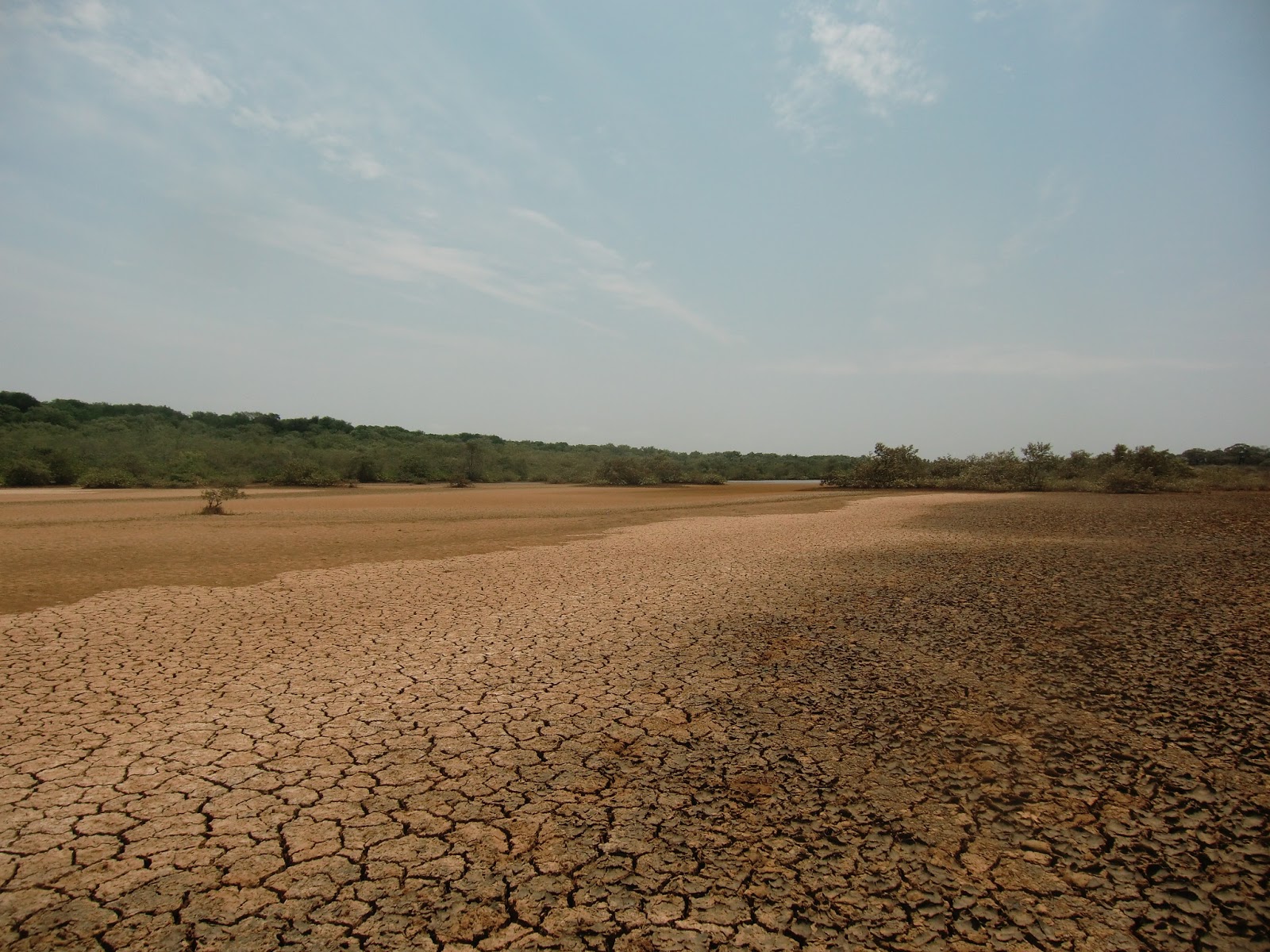
After leaving the wettest and coldest tropical rain forest of Panama, we visited the driest and hottest tropical dry forest of Panama, commonly referred to as the Sarigua Desert. It was incredible to walk through this tropical dry forest-turned desert and forget we were still in Panama. Our professor led us to the archeological site where clay shards of pottery from ancient indigenous people were found (there were so many lying around I was able to pick one up and keep it for myself). Then we explored the sand-dune part of the park where the earth shifted like sand beneath your feet, all due to a combination of wind, water, and human-induced erosion. We continued across seemingly endless dunes until the earth was cracked and hard under our feet (the result of quick changes in temperature from night to day). We trekked further into the desert to find the dwindling mangrove forest and the shrimp farms that had replaced them. Once again, the wind was awe-inspiring as it whipped across the landscape and exfoliated your skin with its endless plumes of dust. We left Sarigua exhausted, dehydrated, and dirt-covered from head to toe, but I was ecstatic to be able to use my camera again to try to capture a glimpse of the unbelievable landscape.


 Dried cow poop!


 Dead dried algae covered parts of the desert that had previously been underwater


 Mangroves!

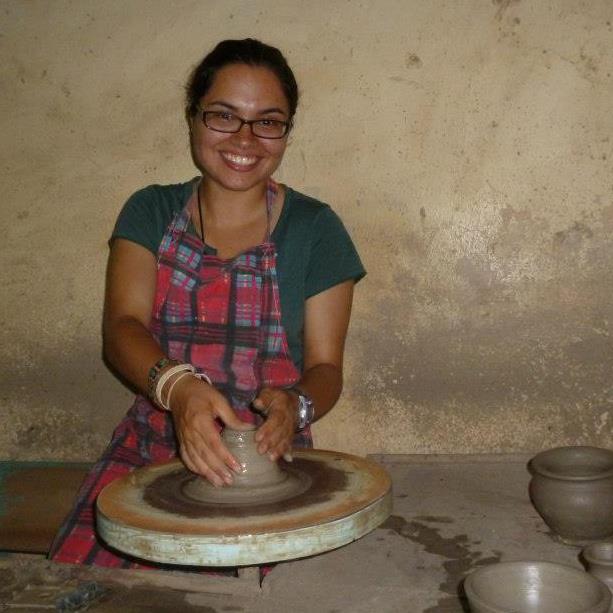
Then we visited the pottery workshop of Sr. Calderon and I got to attempt to use a manual pottery wheel and had a great conversation in Spanish with the owner and his son.
 

We’re currently staying at a hotel in the town of Chitre. I reveled in a hot shower and a flushing toilet and just spend the past 5 minutes sticking my face inside my bag of clean laundry. Tomorrow morning we leave at 8am for the city of David, where I’ll meet my new homestay family for the week while we study local fisheries. I’m ready for another homestay and eager to continue improving my Spanish and can’t wait to snorkel! 
 
View of Chitre's main square from the balcony of our hotel